
Where Is Insulation Used in an HVAC System? A Practical Guide
Most people picture HVAC insulation as one sheet wrapped around everything. In reality, HVAC insulation components differ from one part of the system to the next, so the right choice depends on where each one sits and what it carries.
Ducts carry air. Pipes carry chilled water or refrigerant. Meanwhile, air handlers and plenums house the equipment itself. Each of these parts works at a different temperature, pressure and humidity, so each may need a different material, thickness or vapour-control approach.
When you know where you need insulation, and why, you avoid costly mistakes during design, installation and day-to-day operation.
Quick answer: In a typical HVAC system, insulation goes on supply-air ducts, return-air ducts in humid areas, chilled-water pipes, refrigerant lines, AHUs and plenums. It also goes on the small parts people forget, such as valves, flanges and pipe supports.
What Does HVAC Insulation Actually Do?
Before choosing a material, it helps to know what the insulation has to achieve. Broadly, HVAC insulation does four jobs.
1. Limits Unwanted Heat Transfer
Thermal insulation cuts heat loss from warm ducts and pipes. Similarly, it cuts heat gain into cold ducts and chilled-water lines. As a result, the system uses less energy to deliver the same comfort.
2. Reduces Condensation Risk
Condensation forms when a duct or pipe surface drops below the dew point of the surrounding air. However, insulation with a continuous vapour barrier keeps the outer surface warmer and drier. This protects ceilings, equipment and the insulation itself from moisture damage.
3. Supports System Efficiency
Bare or under-insulated ducts and pipes lose cooling as they pass through unconditioned spaces. Consequently, the HVAC system has to work harder to hold design temperatures at the outlet. Good insulation keeps that loss to a minimum.
4. Manages Sound (Only Where Designed To)
Some products, particularly fibrous materials and composite wraps, absorb sound energy. That said, not all thermal insulation is acoustic. So if noise control is a goal, choose a material with test data for sound absorption.
HVAC Components That Commonly Require Insulation
The table below sums up the main HVAC insulation components, why each one matters and what your supplier will ask before recommending a solution.
| HVAC Component | Why It May Need Insulation | Main Risk If Uninsulated | Information Required Before Selection |
|---|---|---|---|
| Supply-air ducts | Heat loss or gain; condensation risk in humid or unconditioned spaces | Lost cooling efficiency; sweating ducts; system cannot hold setpoint | Duct size, location, operating temperature, ambient humidity, acoustic need |
| Return-air ducts | Condensation risk in humid areas; less critical for efficiency than supply | Water dripping from the duct; damage to ceilings and equipment below | Duct size, location, ambient humidity |
| Fresh-air and exhaust ducts | Heat exchange with outdoor air; condensation where cold air meets humid air | Energy loss; condensation inside or outside the duct | Duct size, indoor or outdoor run, ambient temperature range, operating hours |
| Chilled-water pipes | Condensation on the pipe and insulation; energy loss to ambient | Dripping water; pipe and fitting corrosion; damage below; system overwork | Pipe size, water temperature (typically 4–7°C), ambient temperature and humidity, location |
| Refrigerant lines | Condensation on the cold suction line; heat gain that cuts cooling capacity | Sweating lines; reduced cooling output | Line size, refrigerant type, run length, indoor or outdoor routing |
| AHUs and plenums | Heat exchange through the casing; condensation on outer surfaces in humid climates | Energy loss; condensation and mould on the casing | AHU size, location, internal temperature, ambient conditions |
| Valves and flanges | Often overlooked, so they become cold spots | Dripping water; ceiling damage; corroded valve bodies | Valve type and size, operating temperature, need for access |
| Pipe supports and duct hangers | Bare metal conducts cold and creates local condensation zones | Drips from supports; damage to structure below | Support material, contact area, ambient humidity |
HVAC Duct Insulation
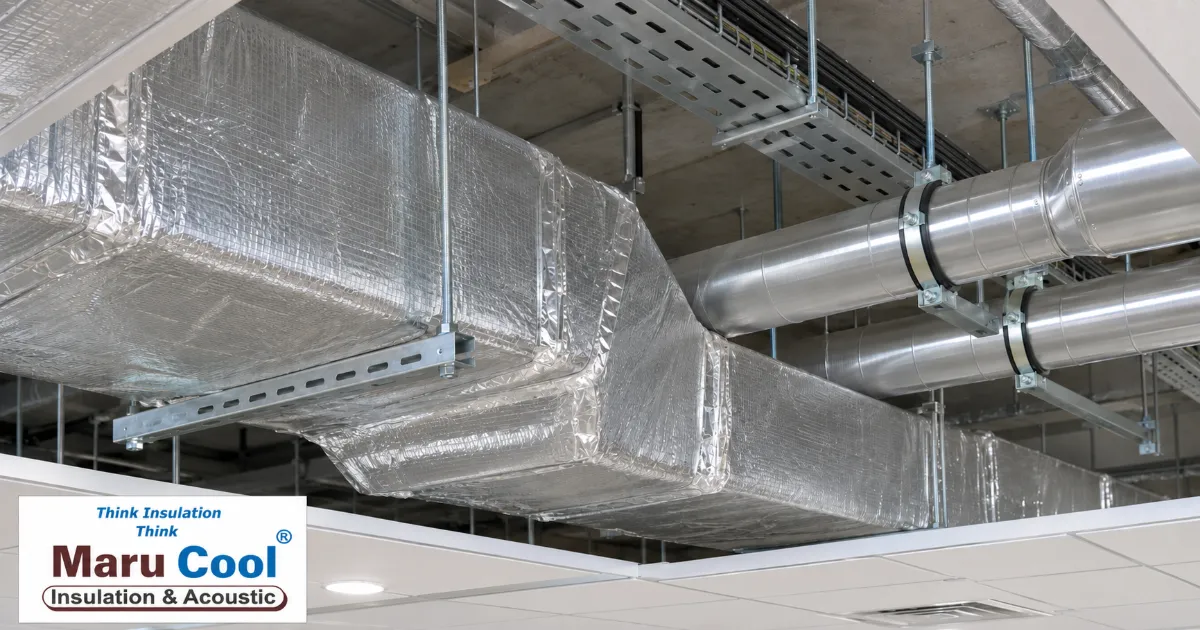
By surface area, ducts are usually the largest of all HVAC insulation components on a project. Supply-air ducts that run through unconditioned spaces, such as false-ceiling voids, terraces, shafts and roof spaces, pick up heat on the way to the room. In addition, the duct surface can drop below the dew point of the surrounding air. A vapour barrier on the insulation stops that from turning into dripping water.
Return-air ducts usually carry warmer air, so they matter less for efficiency. Even so, you should insulate them when they pass through very humid or outdoor areas, because condensation can still form around the return plenum.
For a clear overview of how duct losses add up, see the U.S. Department of Energy’s guide on minimising energy losses in ducts.
Chilled-Water Pipe Insulation
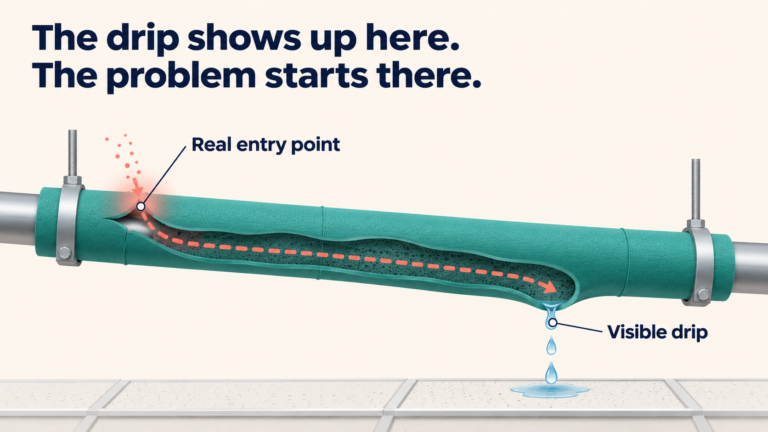
Among all HVAC insulation components, chilled-water pipes carry the highest condensation risk. They usually run at 4–7°C, which is far colder than the air in most Indian climates. Without insulation, condensation is almost certain. For this reason, designers typically choose a closed-cell material such as XLPE foam, nitrile rubber, phenolic or PUF, together with a continuous, low-permeance vapour barrier.
The right thickness depends on ambient humidity, pipe size and design margin. Also, every joint, elbow, valve and support needs insulation and a proper seal, because a single gap can let moisture in.
Refrigerant-Line Insulation
The suction line, the larger of the two copper pipes, carries cold refrigerant gas, so it always needs insulation. The liquid line runs warmer in cooling mode. However, most split and VRF manufacturers ask installers to insulate both lines separately, especially on heat-pump units where the liquid line can run cold in heating mode.
Both lines also face sun, rain and outdoor temperature swings. Therefore, choose UV-resistant insulation or cover it with an outer jacket or tape. Above all, follow the equipment maker’s installation manual for thickness and routing.
AHU, Plenum and Equipment Insulation
Air-handling units often come with factory-fitted insulation in their casing panels, which reduces heat gain and limits condensation on the outer skin. Supply and return plenums, on the other hand, may use rigid board, closed-cell sheet or insulated panels, depending on the design.
Specifications vary from project to project. They depend on equipment size, whether the unit sits indoors or on the roof, and whether the space around it has air conditioning.
Thermal Insulation vs Acoustic Treatment
Thermal insulation mainly controls heat flow, whereas acoustic insulation mainly absorbs sound.
- Thermal insulation: Low conductivity, often with a vapour barrier, and thickness based on the thermal performance you need. Examples include XLPE foam, nitrile rubber, PUF, phenolic and fibreglass wrap.
- Acoustic insulation: Porous structure that absorbs sound, and it may not include a vapour barrier. Examples include fibrous duct lining, melamine foam and acoustic board.
Some materials do both jobs. Still, acoustic performance is not something to assume, so ask for test data on sound absorption before you rely on it.
Likewise, never assume an acoustic lining controls condensation. Always check its vapour-barrier performance first. If you want to compare materials in more detail, read our guide to the types of thermal insulation.
HVAC Insulation Details Most Often Missed
In our experience, most condensation and efficiency problems start with the small HVAC components that insulation crews overlook, rather than the main runs:
- Joints: Unsealed seams between sections let humid air slip behind the insulation.
- Flanges and connections: Bare metal flanges conduct cold and quickly become condensation hotspots.
- Access doors: Teams often open removable panels for service and then forget to reinsulate them.
- Supports and brackets: Metal hangers that touch cold ducts or pipes create thermal bridges.
- Valves: Installers often skip isolation, check and balancing valves.
- Terminations: Gaps tend to appear where ducts end or where pipes meet equipment.
- Outdoor protection: UV and rain break down exposed insulation, yet many sites skip cladding or protective coating.
Getting these details right at the design and installation stage saves you from expensive repairs later.
What to Include in an HVAC Insulation Enquiry
When you ask a supplier for a recommendation, share these details up front:
- Component type: Duct, pipe, refrigerant line, AHU or plenum
- Operating temperature: Supply-air temperature, chilled-water temperature or refrigerant type
- Dimensions: Duct size (height × width or diameter) and pipe diameter
- Installation location: Plant room, false ceiling, shaft, terrace or outdoors
- Ambient conditions: Typical indoor and outdoor temperature, humidity (%) and seasonal variation
- Operating hours: Year-round, seasonal or on demand
- Special requirements: Acoustic performance, fire rating, UV resistance or space limits
With this information, a supplier can match the material, thickness and vapour-barrier approach to each of your HVAC insulation components. To see what is available, browse MaruCool’s duct and pipe insulation range.
Standards and References
For design values such as vapour-retarder permeance and minimum thickness, engineers usually refer to the ASHRAE Handbook – Fundamentals. In India, the Bureau of Energy Efficiency’s Energy Conservation Building Code (ECBC) also sets insulation requirements for commercial HVAC piping and ductwork.
Final Takeaway
HVAC insulation is a system decision, not just a material decision. Ducts, pipes, refrigerant lines, air handlers and fittings are all HVAC components, yet each works under different conditions. Therefore, the insulation for each one may differ too.
A one-size-fits-all approach often fails because it ignores the temperature, humidity and durability needs of each part. In contrast, when you plan insulation for each of the HVAC components on its own terms, you get better designs, fewer condensation problems and lower running costs.
Send MaruCool Your Requirement
Planning a new project or fixing a sweating duct? Share the HVAC component, operating temperature, dimensions, installation environment and project details with us. Then our team will suggest the right insulation for the job. Contact MaruCool to get started.
FAQs
Which parts of an HVAC system need insulation?
Supply-air ducts (especially in unconditioned spaces), chilled-water pipes, refrigerant lines, AHUs and plenums all need insulation. So do valves, flanges and supports that touch cold surfaces. Return-air ducts may also need it in humid climates. Exact requirements for these HVAC insulation components depend on location, operating conditions and design goals.
Is duct insulation the same as pipe insulation?
No. Duct insulation is often a closed-cell sheet (XLPE or nitrile) or a fibreglass wrap, sometimes with an internal acoustic lining. Chilled-water pipe insulation, by contrast, is usually closed-cell foam with a low-permeance vapour barrier. Meanwhile, refrigerant lines use flexible foam tubing, often UV-resistant. Each one works best when you match it to its application.
Why do chilled-water pipes need vapour control?
Chilled-water pipes run far below ambient temperature. As a result, water vapour in warm, humid air moves strongly towards the cold pipe. Without a vapour barrier, that vapour passes through the insulation and condenses on the pipe surface. A low-permeance barrier (ASHRAE suggests 0.02 perm or lower for below-ambient piping) slows this movement and keeps moisture out.
Does HVAC insulation also reduce noise?
Some products do absorb sound, particularly fibrous materials and composites. However, thermal and acoustic performance are different properties. So if noise reduction is a project goal, check the acoustic ratings rather than assuming thermal insulation will help.
Can you use one insulation material for the complete HVAC system?
Usually not. Ducts, chilled-water pipes, refrigerant lines and equipment each have different needs. For example, a fibreglass duct wrap may suit supply ducts well but fail on chilled-water pipes, which need closed-cell foam. Using the wrong material wastes money and often fails to stop condensation or energy loss.
One Comment