
Factory Shed Overheating? Effective Solutions to Reduce Roof Heat
Step into your factory at 2 PM in May. If your first thought is, “It feels like standing inside a tandoor,” you aren’t alone. Across India, thousands of factory shed owners struggle with this seasonal heatwave, often relying on fans and vents that simply circulate hot air.
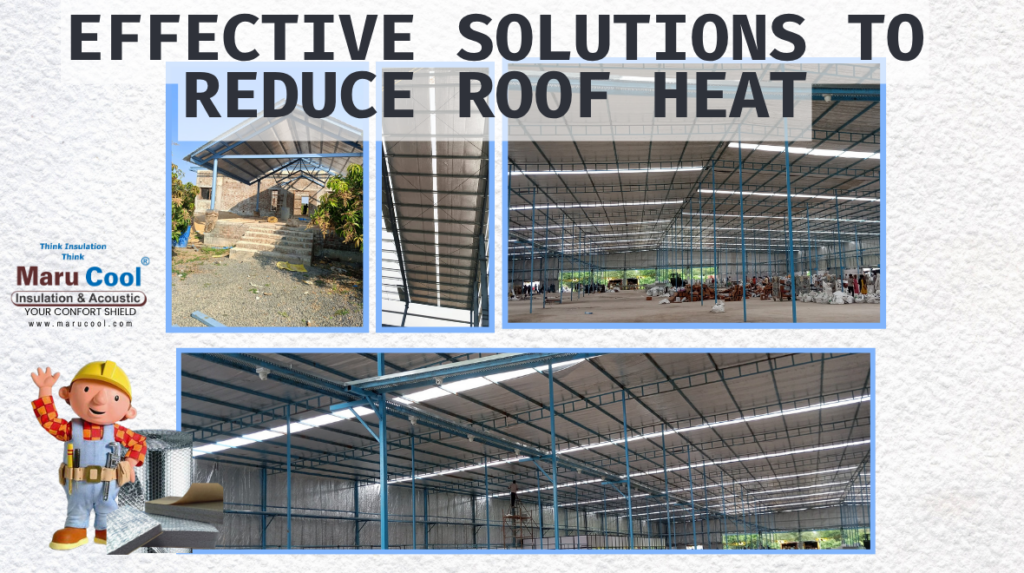
The truth is, those traditional methods aren’t enough. If you’re wondering how to reduce roof heat in factory shed, the answer isn’t more fans, it’s fixing the root cause. Let’s break down the most effective ways to cool your workspace, no complex technical talk, just straight answers.
Understanding Why Factory Roofs Get Too Hot
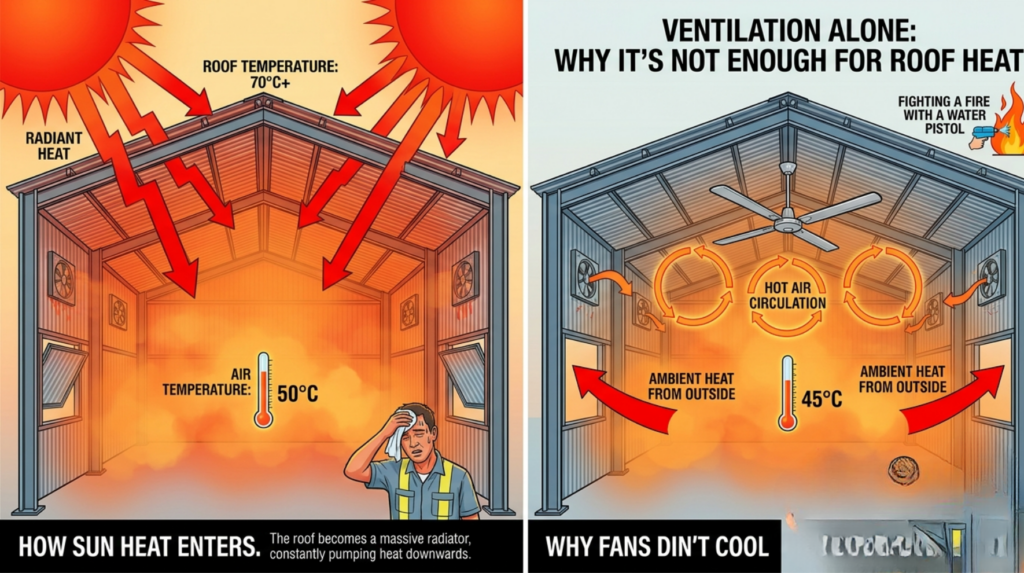
Your factory roof most likely a metal or tin sheet sits directly under the sun for 8 to 10 hours a day. Metal is an excellent conductor of heat. So when the sun beats down on it, the roof does not just get warm. It gets scorching hot, sometimes reaching surface temperatures of 60°C to 80°C in peak summer.
That heat then radiates downward into your workspace. Workers feel it. Machines run hotter. Products get affected. And your electricity bill for cooling shoots up.
The metal roof heat problem is not just about discomfort. It directly impacts output, worker health, and operational costs.
How Radiant Heat Enters Through Metal Roofing
Here is something most people do not realize: the sun does not just heat your shed through hot air. It heats it through radiation.
Radiant heat travels in waves, just like light. When sunlight hits your tin or metal roof, the roof absorbs that energy and re-radiates it as heat downward, into your shed. This happens even if there is decent airflow around the building.
Think of it like a grill plate. You do not need to touch the flame to feel the heat. The hot surface alone will cook you.
This is why metal sheds feel unbearable even when there is a breeze outside. The roof itself has become a secondary heat source inside your building. Until you address this radiant heat, no amount of fans or open windows will fully solve the problem.
Why Ventilation Alone Cannot Reduce Roof Heat
“Just open more windows.” “Put in exhaust fans.” “Add a turbo ventilator on the roof.”
You have probably tried these. And yes, they help a little. But here is the hard truth: ventilation only moves hot air around. It cannot remove the heat that is radiating from your roof.
If your roof surface is at 70°C, it is pumping heat into the shed constantly. A fan just pushes that hot air from one side of the shed to another. In extreme Indian summers, outside air temperature itself crosses 40°C, so you are basically just exchanging one hot air for another.
Ventilation has a role. But it is a support player, not the main solution. If you are relying only on airflow for your warehouse heat issue, you are fighting a fire with a water pistol.
Best Way to Reduce Roof Heat in Summer
The most effective solution is stopping heat before it enters your shed. And the best way to how to reduce roof heat in factory shed is roof insulation not more fans, not just ventilation.
Good roof heat insulation works in two ways:
- Reflection — bouncing sunlight and radiant heat away from the roof before it gets absorbed
- Resistance — slowing down how fast heat transfers from the hot roof surface into your building
When you combine both, you significantly reduce the indoor temperature, sometimes by 8°C to 15°C without any electricity. That means your cooling systems work less. Workers are more comfortable. And the shed stops feeling like a furnace.
The best results come from installing insulation under the roofing sheet, between the metal and the interior of your shed.
Top Roof Heat Insulation Materials for Industrial Sheds
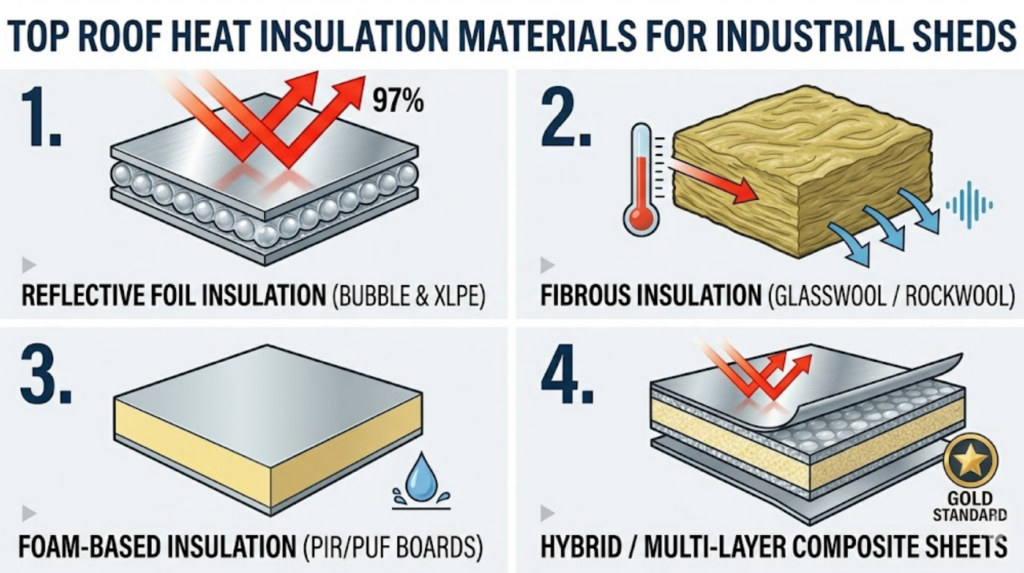
1. Reflective Foil Insulation (Bubble & XLPE)
These are thin, lightweight sheets featuring aluminum foil layers bonded to a bubble or Cross-Linked Polyethylene (XLPE) foam core. They work by reflecting up to 97% of radiant heat before it can penetrate the building.
- Best for: Metal shed roofs in high-heat zones.
- Why it works: It’s easy to install and specifically designed to tackle the intense solar radiation common in Indian summers.
2. Fibrous Insulation (Glasswool / Rockwool)
These materials consist of dense fibers that trap air to slow down heat conduction. While they are excellent thermal barriers, they are most effective against “ambient” heat rather than direct sun rays.
- Best for: Roofs that already have some shading or where soundproofing is also a priority.
- Pro Tip: For maximum impact in a factory setting, always use a version with a reflective foil facing to handle radiant heat.
3. Foam-Based Insulation (PIR/PUF Boards)
Polyisocyanurate (PIR) or Polyurethane (PUF) boards provide high thermal resistance ($R$-value) in a very slim profile. They are rigid, durable, and don’t sag over time.
- Best for: Sheds with limited clearance or where a clean, professional “ceiling” look is desired.
- Advantage: They offer long-term structural integrity and superior moisture resistance.
4. Hybrid / Multi-Layer Composite Sheets
This is the “gold standard” for Indian industrial sheds. By combining a reflective outer surface with a thick foam or bubble core, these composites address both radiant heat (from the sun) and conductive heat (from the hot metal).
- Best for: Maximum temperature reduction in extreme climates.
- The Verdict: If you are looking for the absolute best insulation material for a roof in a hot, sunny environment, this hybrid approach is your best bet.
Cost-Effective and Long-Lasting Insulation Solutions
A common concern: “This must be expensive.”
Here is the reality check. The upfront cost of roof insulation typically pays for itself within 1 to 2 summers through reduced cooling costs and improved worker productivity.
What makes a solution cost-effective and long-lasting:
- Low maintenance — Good reflective foil or composite insulation requires virtually zero maintenance once installed. No replacements, no top-ups. It just works.
- Durability — Quality insulation materials last 15 to 25 years without performance drop. Compare that to buying fans and ACs every few years.
- Energy savings — Reducing indoor temperature by even 8°C can cut your cooling electricity usage by 20–35%.
- Worker retention — In extreme heat, worker absenteeism and fatigue are real costs. A cooler shed means people actually show up and work well.
When you calculate total cost of ownership, insulation is among the most affordable long-term investments for any industrial shed. And unlike AC systems, it works even during power cuts.
How Roof Insulation Improves Shed Temperature & Productivity
A mid-sized factory in Rajasthan with a tin roof was clocking indoor temperatures of 52°C in peak summer. Workers were taking frequent breaks, productivity was down 30%, and two industrial fans were running nonstop. This is exactly why knowing how to reduce roof heat in factory shed matters, not just for comfort, but for business performance. After installing multi-layer reflective insulation under the roof, indoor temperatures dropped to around 38–40°C. The fans were still used but ran half as often. Worker output improved noticeably within the first week.
This is not unusual. A cooler work environment directly leads to:
- Fewer health complaints among floor staff
- Better concentration and output — heat is a known cognitive impairment
- Reduced machine downtime — many industrial machines have heat-sensitive components
- Lower electricity bills — cooling systems run less
- Compliance with safety norms — OSHA and Indian factory act guidelines recommend safe thermal conditions
The right insulation does not just fix a temperature problem. It fixes a business problem.
Conclusion
Your hot factory roof is not a seasonal nuisance you have to live with. It is a solvable problem with proven materials and straightforward installation. The key is to stop treating it as an airflow issue and start treating it as a radiant heat problem, which requires the right insulation, not just more fans.
Whether you are running a manufacturing plant, a warehouse, a cold storage facility, or an assembly unit if you have a metal or tin roof, insulation should be at the top of your summer checklist.
Cool shed. Better work. Lower bills. It is that simple.